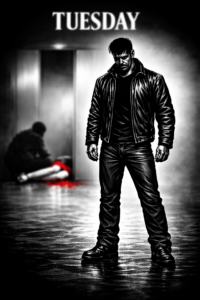
Have you ever wondered where screenwriters get their ideas? Those stories where someone’s life flips a full one-eighty, where everything ordinary becomes something you wouldn’t wish on your worst enemy? Those where you sense from the very first scene that things aren’t going to end well. I used to wonder about that too. Until recently. Now, smoking my fifth cigarette in a row, I’m beginning to understand that I might be the perfect muse for exactly that kind of film. The dramatic kind. Honestly, two weeks ago I didn’t see it that way. But isn’t that the most typical trait of the protagonist? Blissful ignorance. The unshakeable, almost embarrassing conviction that you have your life completely under control. Maybe it’s better if I just tell you what happened, instead of feeling sorry for myself again. Three cigarettes ago I decided it wasn’t worth it.
My name doesn’t matter. What matters is that, until a couple of weeks ago, I was one of those people others quietly envy. Not the flashy kind of envy — not yachts or sports cars. The quiet kind. I have a job that doesn’t drain the life out of me. A wife who still makes me laugh after twelve years together. Two kids who are simultaneously exhausting and the best thing I’ve ever done. We live in a decent building in a decent part of the city, and on most evenings I’d sit by the window with a coffee and think that life, all things considered, wasn’t bad at all.
Stefan was the other kind.
We’d been friends since we were nineteen — long enough that I’d stopped questioning why. He was the kind of person misfortunes simply happen to. Not catastrophic things, not always — but a constant, grinding stream of bad luck and hasty decisions. A business deal that almost worked. A car rear-ended twice in the same year, always someone else’s fault. A misunderstanding with the police over something that turned out to be nothing, but left a mark on him, on the station’s chief, and on his record. His wife was patient in the way that people are patient when they’ve run out of alternatives. His kids were fine. Stefan himself was — Stefan. Warm, funny, the kind of person who would give you their last possession without thinking twice. I loved him the way you love people you’ve known so long they’ve become part of yourself.
I should have noticed the small cracks in his image sooner.
It was a Tuesday afternoon. I remember because I was working from home and had just finished a call that had gone on forty minutes longer than it needed to. I was making coffee when my phone rang.
Stefan.
„Are you home?“
„Yeah.“
„Can you come down? To the lobby.“ A pause. „Take the stairs. Don’t use the lift.“
I almost laughed. „What?“
„Please. Just — take the stairs.“
Something in his voice stopped me from pushing further. I put on shoes, told Marta I’d be back in a minute, and took the stairs.
Stefan was standing beside the elevator. He was pale in a way I’d never seen before — not the pale of illness, but the pale of shock, the kind that drains a person from the inside out. His jacket had something dark on it. My brain registered it slowly, the way the mind resists things it doesn’t want to know.
Blood. I looked at him. Then I looked at the elevator. The doors were open. Inside, on the floor, a woman. I didn’t know her face at first — not until later, when I’d seen it enough times on the news that I wished I could unknow it. She wasn’t moving. She was very clearly not going to move again.
„Stefan.“ My voice came out strange. Flat. „What is this?“
„I found her.“ He said it fast, like he’d been rehearsing. „I wanted to come up and see you, you understand? I called the lift, and when the doors opened — she was there. Like that. Already like that.“
„Did you—“
„No!“ He grabbed my arm. His hand was shaking. „I swear to you. You know me.“
The thing is, I did know him. And I also knew his luck, and his history with the police, and the way the world had a habit of arranging itself badly around him.
„I need your help,“ he said. The words came out quietly, almost carefully, as if he’d been building up to them since he called. „I need to move her. Somewhere. Just — away from here. If they find her like this, with me standing next to her—“ He stopped. Swallowed. „You know what they’ll think. I can’t afford that, not now.“
I stared at him.
„I can’t,“ I said.
„Five minutes. Just—“
„Stefan. No.“ I said it clearly. Firmly. The way you say something when you need to believe it yourself.
For a very long moment he looked at me without moving his eyes. Something moved across his face — disappointment, maybe, or desperation shifting into something more controlled. More inevitable.
„Then just go back upstairs,“ he said quietly. „And don’t say anything. For now. Just give me time to think.“
I stood there in the stairwell light, with the open elevator behind him and the crushing scene we had all found ourselves in. Then I nodded once, turned away from the open elevator doors, and went back up the stairs without looking behind me. Some part of me understood that not looking was also a choice.
Marta was in the kitchen when I came back. She looked at my face and immediately turned off the stove.
I told her everything. She listened without interrupting — one of the things I’ve always loved about her. She never performs shock, she just takes it in and engages with what you’re saying.
When I finished, she was quiet for a moment.
„Do you believe him?“
„I don’t know.“
„But you didn’t stop him.“
„What was I supposed to do? Turn him in on the spot? On the chance that—“
„I’m not saying you were wrong,“ she said carefully. „I’m asking what we do now.“
We decided to do nothing. For now. Just nothing. It felt like a decision at the time. Later I understood it was the first in a series of small surrenders.
Stefan went quiet. No calls, no messages. The kind of silence that has weight.
I checked my phone more times than I want to admit. I told myself it was concern. Mostly it was dread. The two can look identical from the inside.
A week passed. It was a Tuesday again. I’d almost convinced myself it had been some kind of surreal dream — the kind your mind produces when you find yourself in a situation you were never prepared for and never imagined you’d face. Then the news mentioned a missing woman from our building. A neighbor. Fifty-three years old. Hadn’t been seen in a week.
I went through the news three times. Then I turned off the television and sat very still for a while.
That same evening, Georgi’s invitation arrived. A weekend at his villa. Both families — mine and Stefan’s — were welcome. Marta read it over my shoulder and said nothing for a long moment.
„Maybe it would do us good. We’d clear our heads. We’d realize this whole thing is some bad joke,“ she said finally.
She didn’t sound convinced. Neither was I.
The drive to Georgi’s villa takes about an hour and a half. For the first twenty minutes neither of us said anything. The kids were asleep in the back before we even left the city.
„I’ve been thinking,“ I said eventually.
Marta kept her eyes on the road. She was driving. She always drives when she’s tense — it gives her something to do with her hands.
„Don’t,“ she said.
„Marta—“
„I know what you’re thinking. And I’m telling you — not this weekend. We go, we smile, we come back. That’s it.“
„And then what? We just—“
„We just nothing.“ Her voice was quiet but firm. The firmness that means the conversation is over. „Stefan is our friend. We don’t know anything. We didn’t see anything. As far as anyone is concerned, we had a normal day.“
I looked out the window at the dark fields passing by.
„And if it gets worse?“ I asked.
She didn’t answer. Which was its own kind of answer. I didn’t bring it up again for the rest of the drive.
The villa was everything Georgi’s places always were — tasteful, comfortable, slightly too large for the number of people using it. He greeted us at the door with wine and that wide, easy smile of his that never quite reaches his eyes. I’d never noticed that before. I noticed it now.
Stefan arrived an hour after us. Alone.
„Elena couldn’t make it,“ he said, pulling out his bag. „The kids had something at school.“ He said it lightly, the way you’d mention traffic or weather. His smile was easy, natural. His eyes moved around the room in a way that looked casual. But wasn’t.
That night, after the kids were in bed and the adults had moved to the terrace, Marta leaned over and whispered that she was going to call Elena in the morning. I nodded. She did call, the next day, while I was having coffee. She came back into the kitchen a few minutes later and put her phone face-down on the table.
„She picked up,“ Marta said.
„And?“
„She said everything was fine. She sounded—“ She paused, searching for the word. „Careful.“
We looked at each other. Neither of us said anything else.
It was the second evening when Georgi arranged what he called a casual after-dinner conversation. He did it the way he did everything — naturally, as if it had just occurred to him, as if he hadn’t been thinking about it all weekend.
We were all at the long table on the terrace. Wine, candles, the warm night air. Stefan was at the far end, laughing at something one of the other guests had said. Relaxed. Present. Untouchable.
Georgi leaned back in his chair and said, almost idly, that he’d been reading about the missing woman from our building.
The table seemed to shift slightly. The way rooms shift when something unseen moves through them.
„Terrible thing,“ he said, swirling his glass. „A woman just — gone. From her own building.“ He looked at no one in particular. „You knew her, didn’t you? You lived on the same floor, or am I mistaken?“
He was looking at me.
I felt Marta freeze beside me.
„We knew her vaguely, enough to say hello,“ I said. „I wasn’t even sure which floor she lived on.“
„I see.“ Georgi nodded slowly, as if this confirmed something. „Still, I imagine you feel unsettled. When something like that happens so close to home…“ He paused. „Does the police suspect anyone from the building?“
„I wouldn’t know,“ I said.
„No, of course not.“ Another slow nod. That smile again. „These things always come out in the end. Or they don’t. Either way, life goes on.“
He said it like a man who found the whole thing insufficiently interesting. As if he were talking about the rising price of milk. Like a collector examining a common find locked behind glass.
Beside me, I heard Marta’s chair scrape back. She excused herself quietly — said she was going to check on the children. Her voice was calm. Her hands, as she set down her glass, were not.
I watched her go. Then I looked down the table at Stefan, who was refilling someone’s wine and laughing, and who had not looked up once during the entire exchange.
Georgi saw me looking at Stefan.
When I met his eyes, he smiled and changed the subject.
We didn’t speak about it until we were in bed that night, door closed, voices low.
„He knows something,“ Marta said. She was staring at the ceiling.
„Maybe. Or he’s just—“
„Don’t. Don’t tell me he’s just making conversation.“ She turned to face me. In the dark I could see that her eyes were wet. Not crying — Marta doesn’t cry easily — but close, very close to it. Closer than I’d seen her in years. „I left because I couldn’t sit there anymore. I couldn’t watch Stefan laughing like that and Georgi observing us as if we’re — as if we’re some kind of experiment—“ Her voice broke slightly. She pressed her lips together. „I’m scared,“ she said. Just that. Simply.
I reached for her hand under the covers.
„We’ll leave tomorrow,“ I said. „And then we’ll figure it out.“
She nodded. But I could feel, from the way she held my hand — too tight, like someone holding onto something they’re afraid of losing — that she didn’t entirely believe me.
We came home on Sunday. On Tuesday Stefan appeared at our door.
He looked normal. That was the most unsettling thing. Rested, almost — as if nothing had ever happened to him, as if life had never dealt him a single blow. He brought a bottle of wine he said he’d owed me for months. He sat at our kitchen table and talked about his car needing new tyres, about a film he’d seen. About nothing of substance. The wine sat between us, unopened.
„How’s Elena?“ Marta asked at some point. Her voice was perfectly even.
„Fine,“ Stefan said. „Good. Busy with the kids.“
„And the kids?“
„You know how it is.“ He smiled and looked at his hands. „The usual.“
The usual. It told us nothing, and somehow that only added more weight and heaviness to the silence between us.
After he left, Marta washed the wine glasses we hadn’t used and didn’t say anything for a long time. Then she sat down across from me.
„I tried to reach Elena again this morning,“ she said. „No answer.“
I nodded.
„She was careful on the phone at the villa. That’s not nothing.“
„No,“ I agreed. „It’s not nothing.“
The kitchen was very quiet.
Another week passed. It was a Tuesday again. Marta and I had become like strangers somehow. As if we were contestants in a reality show that required us to live together and raise two children. Everything had become mechanical. Quiet.
„I can’t keep doing this,“ Marta said. Her voice, for the first time since all of this started, had lost its steadiness. Not dramatically — Marta doesn’t do dramatic — but she was coming apart in a way I recognized. She pressed her fingers flat against the table, as if trying to hold herself together. „I keep thinking about that woman. About her family. About whether someone is sitting somewhere waiting for her to come home and not understanding why she doesn’t.“ Her jaw tightened. „And then I think about our kids sleeping in the next room and I—“ She stopped. Exhaled. When she looked up her eyes were red. „We haven’t done anything wrong. But we’re not doing anything right either. And I don’t know how much longer I can carry that.“
I didn’t have an answer. I just sat there and looked at the woman I’d spent twelve years with, who had lived through so much in these past few days. I understood, for the first time, what this was costing both of us.
„Let me think tonight,“ I said finally. „Let me think.“
She nodded and wiped her eyes quickly, almost impatiently, as if she hadn’t meant to let them show.
„One night,“ she said.
I told her I needed some air.
That was an hour ago. I’ve been standing outside since then, working through cigarettes like they’re arguments I haven’t finished yet.
Georgi called twice during that week after the villa. The first time he asked how we were, whether the kids had enjoyed themselves. Normal enough. But near the end of the call, completely out of nowhere, he said: „You know, I keep thinking about what we were discussing at dinner. About the woman from your building. It must be strange, living there now. Knowing that something like that happened and nobody seems to know anything. Anyone there could be in danger.“ A pause, just long enough. „Or maybe someone does know. Who knows…“ Then he laughed lightly and said to give his regards to Marta.
I’ve replayed that call more times than I’d like to admit. I still can’t decide what he meant or why.
I called Stefan. His phone sent me to voicemail.
The fifth cigarette burns low between my fingers. The city moves around me the way it always does — indifferent, hurried, full of people living their ordinary Tuesday evenings without any idea how lucky they are.
I think about Marta’s hands pressed flat against the table. I imagine I can hear Elena’s careful voice on the phone, explaining quietly and meekly that everything is fine, that she and the children are alright. About Georgi’s laugh at the end of that call. About the woman in the elevator whose face and ending will stay with me forever. About the moment on the stairwell landing when I turned away from the open elevator doors and told myself that not helping was the same as not being involved.
And then I see him.
Across the street. Thirty meters away, maybe less. Hands in his pockets, walking in the other direction. Unhurried. Calm. As if his troubles have evaporated. As if everything is fine and the world is exactly as it should be.
He didn’t see me.
I watch him until he turns the corner and disappears.
The cigarette burns down to my fingers. I drop it.
I stand here a moment longer in the cold, in the noise, in all that ordinary evening life pressing in from every direction. Marta is right. We haven’t done anything wrong, but we haven’t done anything right either. And that has its price.
Then I take out my phone.
___________________________________
Българска версия – https://kaloyan.org/vtornik-noir-story/
Pingback: Вторник – noir история - noir история
Nice
Pingback: Thursday – a noir story - kaloyan.org